
AI Briefing / Ollama / Gradium
Phonon brings local speech to Ollama. Check the licence first.
By Mimir IT Consultation Services · Sources checked 25 October 2026
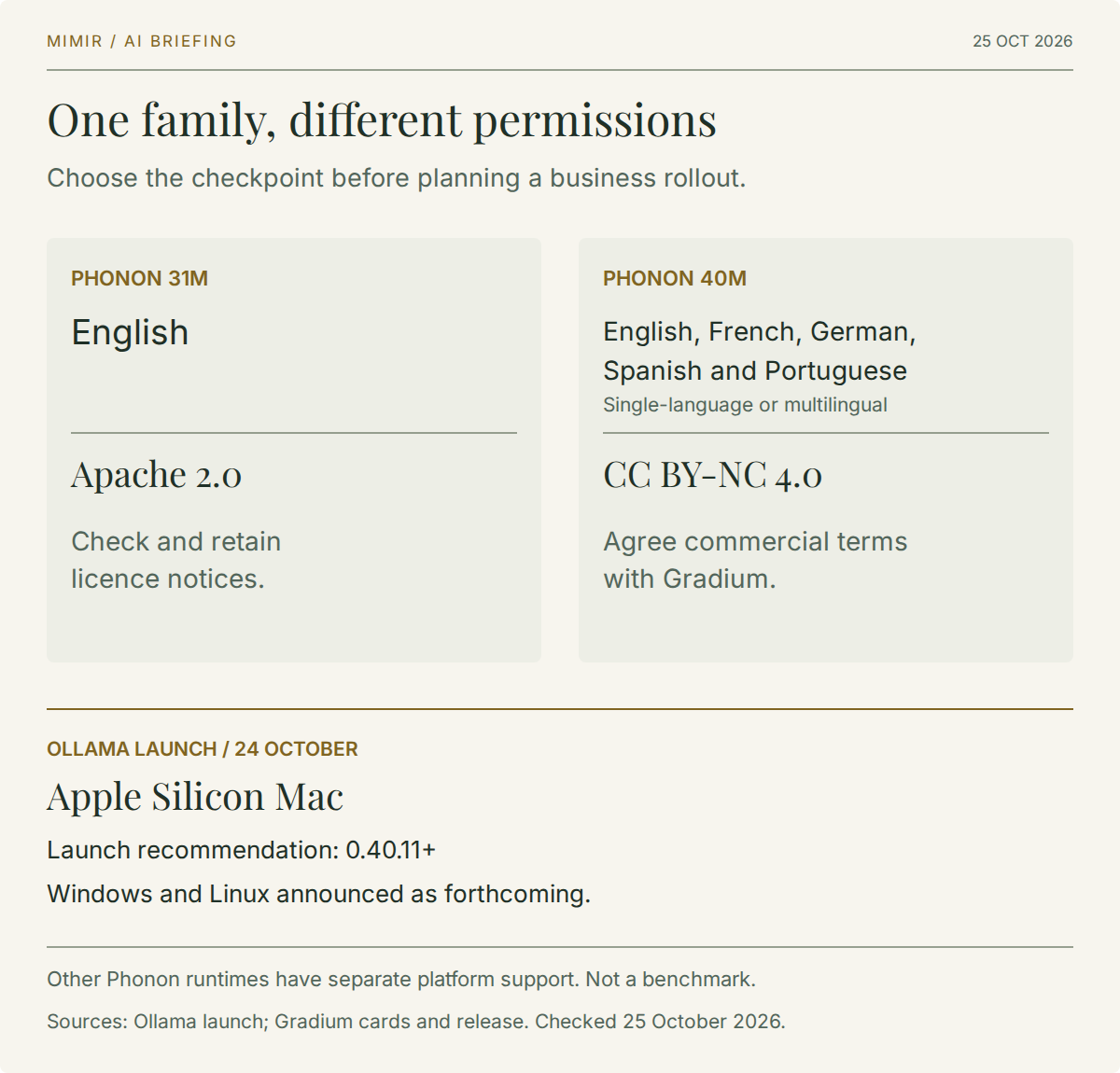
Ollama added Phonon text-to-speech support on 24 October 2026. For a business exploring spoken internal guides, narrated instructions or a local assistant, it creates a useful pilot opportunity. Start by checking the exact model and deployment route: the English 31M model and the 40M variants do not share the same licence.
Ollama's announcement describes an Apple Silicon release, with Windows and Linux support still forthcoming. This is an integration update, rather than the first release of Phonon. Gradium published the open-weight family on 20 October.
Choose the model before the voice
The Phonon 31M English model card identifies an English speech model under Apache 2.0. The 40M family covers English, French, German, Spanish and Portuguese through separate language models and a multilingual variant. Those checkpoints use CC BY-NC 4.0. Gradium directs commercial-use enquiries for the 40M family to its team.
That distinction belongs in the project brief. A business should not assume that downloading another language tag preserves the permissions of its English prototype. Record the checkpoint, licence and any separately agreed terms alongside the application configuration.
The CC BY-NC licence summary includes a noncommercial restriction. For a proposed commercial deployment of a 40M variant, obtain suitable terms from Gradium before proceeding. For the Apache-licensed model, retain the applicable licence and notices when distributing it, following the Apache 2.0 conditions. A model licence also does not settle permissions for every voice or recording used with it.
Our recommendation is to separate the initial technical trial from the deployment decision. An English demonstration on a supported Mac can answer a narrow feasibility question. It cannot establish that the same arrangement is suitable for a multilingual customer service.
Check the actual Ollama route
The launch post recommends Ollama 0.40.11 or later. The speech documentation currently gives 0.40.9 as its minimum. Use the newer launch recommendation for a pilot and record the installed version. Treat Windows and Linux availability as unconfirmed for this Ollama release until the current release documentation establishes support.
Gradium documents other runtimes and platforms. Their availability does not prove that an Ollama package works on the same devices. An existing Linux server is therefore not, by itself, a reason to schedule this Ollama feature into production.
The documented API is /v1/audio/speech. It produces 24 kHz mono audio, with WAV and raw PCM options. The guide sets a 4,096-character request limit and says unsupported options return an error. Compatibility with an OpenAI-style endpoint should prompt an integration test, including formats, voice selection, text length and failure handling.
For the first trial, use a short, non-sensitive passage. Keep the written version available so reviewers can compare the spoken output with the intended wording.
Measure the experience people will hear
A fast generation rate and a quick start are different measurements. For a read-aloud application, test both the delay before audible playback and whether playback continues smoothly. For prerecorded training material, also measure the time needed to generate and review the complete file.
Ollama reports an Apple Silicon throughput comparison using a MacBook Pro with M5 Max, 45 seconds of speech and the median of ten runs. The compared runtimes use different numeric representations. That is vendor evidence under stated conditions, not a measurement of your device or application. We have not tested Phonon ourselves.
We recommend recording model revision, Ollama version, hardware, voice, input text, warm or cold start, concurrent requests and audio duration. Measure the application path, including buffering and playback. Our guide to reading AI benchmarks explains why results from different setups should not be merged into a single ranking.
For quality, include the words your staff actually need: company names, product codes, abbreviations and written dates. Have an appropriate language speaker review each language you plan to use. A pleasant sample voice is only one part of acceptance.
Local speech is one part of the data path
Generating speech locally can be useful where sending the source text to a hosted speech service is undesirable. Still, inspect the whole application: where its text originates, where logs are stored, whether any assistant uses a cloud model, and where recordings are saved.
Ollama's FAQ documents a local-only setting that disables its cloud models and web search. That setting does not describe every component surrounding Ollama. We recommend checking the complete data flow before claiming an application works offline or keeps all information on the device.
This is separate from deciding what a voice-enabled assistant may do. Reading instructions aloud does not require permission to alter tickets, send messages or change accounts. Keep those actions separately controlled, as discussed in our AI agents for small business article.
A sensible first use
A bounded internal read-aloud trial is a reasonable starting point when English, supported hardware and the selected model's terms fit the task. Agree who reviews pronunciation, how users return to the written text and what would make the trial stop.
This release is a weaker fit if you need an immediately supported Ollama deployment on Windows or Linux, an unlisted language, or commercial use of a 40M variant without agreed terms. A customer-facing voice service also needs its own operational and accessibility review.
For budgeting, count implementation, hardware capacity, review and maintenance as well as any separately licensed capabilities. Open weights do not remove those costs. The immediate decision is whether a small, well-defined local speech trial solves a real problem for your team.