
Professional Services Automation: Connecting the Departments That Stopped Talking
Your people were hired for their judgement, not to be the integration between two systems.
Professional services automation is the centre of what we do, and the work we would choose if we could only do one thing: finding the places where a business’s departments have stopped talking to each other, and engineering the connection so that people can get back to the work that earns the income.
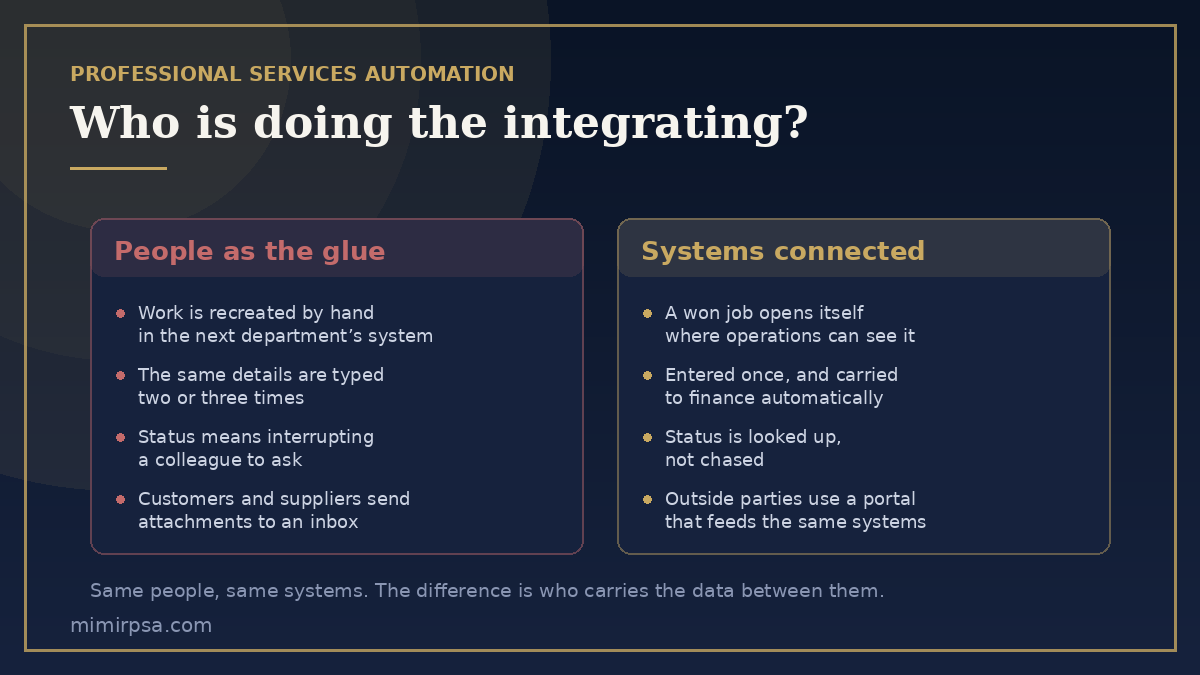
Established businesses tend to share one shape of problem. Sales lives in one system, operations in another, finance in a third, and the space between them is filled by people: someone re-typing an order, someone exporting a spreadsheet every Friday, someone whose real job has quietly become chasing other departments for information that already exists somewhere. None of it is on an org chart, all of it costs money, and it is invisible precisely because competent people are absorbing it.
What we mean by professional services automation
A note on the term, because it is used two ways. In the software market, “PSA” usually names a category of packaged product for running a services firm — time, projects, billing. We mean something wider and more literal: automating the administrative layer of a professional organisation, whatever systems it happens to run on. Sometimes the right answer involves a packaged product. Just as often the products are already there, already paid for, and simply not connected.
So the engagement is not “install a tool”. It is an architecture exercise first: map how work actually moves through the business, find where it stalls or gets re-keyed, and then decide — case by case — whether the fix is configuration, an integration, or something that has to be built.
Where the overhead actually hides
The gaps that professional services automation goes after are rarely dramatic. They tend to look like this:
- The hand-off between departments. A job is won in one system and has to be recreated in another before anyone can start it. Every recreation is a delay and a chance to get a detail wrong.
- The same data entered more than once. Customer details, order lines, time entries — typed into one system, then typed again into the one finance uses.
- The spreadsheet that is secretly a system. One person maintains it, several departments depend on it, and nobody decided it should be critical infrastructure. It simply became that.
- Status by interruption. The only way to find out where something stands is to ask a colleague, which costs two people’s attention every time.
- Reporting assembled by hand. A monthly pack that takes a senior person two days to compile from exports, and is out of date by the time it is read.
- Customers and suppliers on email. Orders, approvals and documents arriving as attachments, because there is nowhere else for an outside party to put them.
Each of those is administration that a skilled, well-paid person is doing instead of the work they were hired for. That is the real cost, and it is why this matters more to a professional firm than to almost anyone else: the product is people’s time, and the overhead is being paid for out of it.
How an engagement runs
Map. We follow real work through the business — an order, a claim, a new client, a month-end — and write down every system it touches, every hand-off, and every point where a person is acting as the integration. This is done with the people who do the work, not from a systems diagram, because the diagram never shows the spreadsheet.
Decide. Each gap gets a deliberate answer. Many close with configuration of what is already licensed; our piece on workflow automation in Microsoft 365 covers how far that goes before it starts costing money. Some need a proper integration between two systems’ APIs. A few need something that does not exist yet. We will tell you which is which, including when the honest answer is to leave a process manual.
Build. The connection is engineered as a piece of infrastructure, not as a favour: it runs under its own service identity, it logs what it did, it fails loudly, and it lives in version control. Those are the same conditions we set out under automation and systems hardening, and they apply with more force here because the business will come to depend on it.
Hand over. Documentation a competent stranger could work from, and ownership that sits with you. The aim of professional services automation is to remove a dependency on people acting as glue — replacing it with a dependency on us would miss the point.
When the answer is a portal, a web app or a backend
Sometimes no amount of connecting existing systems closes the gap, because the missing piece is a place for the work to happen. That is when professional services automation includes software development, and it typically takes one of three forms:
- A third-party portal. Customers, suppliers or contractors get a secure place to place orders, upload documents, sign, approve or check status themselves — feeding straight into the systems behind it rather than into somebody’s inbox.
- An internal web application. The spreadsheet-that-became-a-system, rebuilt as what it always was: a proper application with access control, an audit trail and more than one person who understands it.
- Backend and integration services. The unglamorous part: an API layer or sync service that sits between, say, an ERP and everything else, so each new connection is a small job instead of a project.
We build these ourselves, and we build and run our own business software to the same standard, so the engineering is first-hand rather than subcontracted. Where the estate is Microsoft-based, identity and data access go through supported interfaces such as Microsoft Graph rather than around them, and sign-in rides on the identity provider you already have. A new application should never mean a new set of passwords.
The decision to build is never the default. Custom software is something you own for years, so it has to earn its place against configuring or buying. When it does, the structure matters more than the code, which is why this work is inseparable from IT architecture and design.
What you end up with
A professional services automation engagement is delivered in stages, and each stage leaves something usable behind:
- A written map of how work and data actually move between your departments — useful on its own, and usually the first one the business has had.
- The gaps ranked by what they cost in people’s time, with a recommended fix for each: configure, integrate, build, or leave alone.
- Working integrations and, where justified, a portal or application, delivered in stages so value arrives before the project ends.
- Monitoring, so a failed sync raises an alert instead of surfacing three weeks later as a wrong invoice.
- Documentation and a handover, with security designed in from the start rather than reviewed at the end.
Who this is for
Corporate and professional environments that have outgrown their original systems without replacing them: typically several departments, several line-of-business applications, and a growing sense that capable people are spending their days on administration. If the phrase “we have a spreadsheet for that” comes up more than once in a meeting, professional services automation is probably the highest-return IT work available to you.
It is a poor fit for a business that wants a tool installed without looking at the process underneath. Automating a broken process makes it fail faster. The mapping step is not optional, and it is where most of the value is found.
All of it is delivered remotely as standard, in your working day across the UK and Europe, with on-site workshops where being in the room with the people who do the work is worth the travel. For the ongoing view of where this fits in a wider technology plan, see Virtual CIO advisory.